The fall 2010 sales conferences have ended. There are hundreds of new titles on the way, about which much more to come.
The range of subjects on offer is dazzling, but these are not mainly books insisting on the right answers. They are books about asking the right questions. (Indeed, six of the new titles on the Harvard list are phrased as questions.) In a season when it seems as if every voice in public life is shrieking with certainty, I don’t remember a better assortment of books on how to acknowledge, honor, and use uncertainty.
Here’s a little quiz to whet your appetite. (answers below)
1) A brilliant legal philosopher warns that the world of values needs saving. What from?
2) Which of Jane Austen’s books was most popular in her lifetime, was her personal favorite, and is most widely read today?
3) A prize-winning historian says it’s not the right-left divide we have to worry about, but the growing chasm between the what and the what?
4) How many Facebook friends do you really need (and probably actually have)?
5) What does a leading political thinker call “one of the most pernicious myths of the modern era?”
6) What did Shelley describe as “profuse strains of unpremeditated art?”
7) “Complexity is not the problem.” So what is the problem?
8) What may finally save newspaper journalism?
9) What do Helen Mirren, Jane Tennison, Zane, Kara Walker and the Toxic Titties have in common?
10) With what country was Sigmund Freud obsessed?
11) What is the only animal that points?
12) Who is the most important (but largely unknown to English speaking audiences) poet writing in Arabic today?
13) What important speech will register an anniversary on Jan 17 1961?
14) What was the most effective civic propaganda spectacle of the thirties?
15) Who was the greatest actress who ever lived?
Answers
1) Science! (Ronald Dworkin/Justice for Hedgehogs/Harvard January 2011)
2) Pride and Prejudice (An Annotated Edition, edited by Patricia Meyer Spacks/Harvard October 2010)
3) The private obsession with individual desires vs. tending to our social obligations. (Daniel T. Rodgers/Age of Fracture/Harvard January 2011)
4) Around 150. (Robin Dunbar/How Many Friends Does One Person Need? Harvard/November 2010)
5) The free market as a model for everything. (Bernard E. Harcourt/The Illusion of Free Markets/Harvard/January 2011)
6) Bird song. (John Bevis/AAAAW to ZZZZZD: The Words of Birds/ MIT September 2010)
7) Poor design. (Donald A. Norman/Living with Complexity/ MIT October 2010)
8) Video games! (Ian Bogost et al/Newsgames/MIT October 2010)
9) They are aggressive women, and they are celebrated by contemporary culture. (Maud Lavin/Push Comes to Shove/ MIT September 2010)
10) Mexico. (Ruben Gallo/Freud’s Mexico/MIT September 2010)
11) Humans. (Raymond Tallis/Michelangelo’s Finger/ Yale September 2010)
12) Adonis. (No, not that one!) (Adonis/Selected Poems/ Yale Margellos October 2010)
13) Dwight Eisenhower’s warning about the alarming, creeping power of the “military industrial complex” (James Ledbetter/Unwarranted Influence/ Yale January 2011)
14) The World’s Fairs in Chicago, San Diego, Dallas, Cleveland, New York and San Francisco. (Robert W. Rydell et al/Designing Tomorrow: America’s World’s Fairs of the Thirties/ Yale October 2010)
15) Sarah Bernhardt! (Robert Gottlieb/Sarah:The Life of Sarah Bernhardt/Yale September 2010)
Friday, April 30, 2010

Wednesday, April 21, 2010
Luddite reps get smartphones, love them
My friend Daniel Goldin, proprietor of Boswell Books in Milwaukee, reads while he walks. It’s not something you see many people doing in our city, and I once heard a stranger say to him “Hey I know you, you’re that guy I always see reading and walking.”
I’ve done a fair bit of book-walking myself, and it’s easier than you might think. Peripheral vision is a powerful thing, and you can pretty much count on people to get out of your way when they see you coming. Still, it’s a rare thing to see, at least in my neighborhood.
Judging by the last eight days I spent in Cambridge, New Haven and New York, the world has caught up with Daniel. Except that, alas, instead of being immersed in books, walkers are staring down at their devices. It seems a miracle that the crowds of pedestrians on West 23rd street can avoid constant collisions with other people who are also not paying the slightest attention to where they are going, but they do avoid it! I am taking this as an argument for more reading-while-walking.
We do seem to have reached some sort of tipping point when it comes to smart phones. When people my age and above are obsessively poking away at their little screens in public, the transition to a computer in every pocket seems well underway.
The smart phone wave has even hit the Harvard/MIT/Yale rep force. Three weeks into going from mere phones to devices, every sales meeting break prompted iphones and blackberries being whipped out around the table. In past seasons, a ten minute break announcement sparked a run to the restroom and the coffee urn; as of this week, checking incoming email and texts seems to have supplanted creature comforts on the sales conference break priority list.
There's no denying it's a powerful tool. Minor questions and disputes- "Is this really the first book on this subject? What about that one by whatshisname that so and so published? What was it called?" - can be resolved instantly. There are subtle little contests to see who can wiki faster and come up with useful factoids.
Me, I have mixed feelings about it. So far I’m loving my droid. It's an undeniable rush to be able to triage incoming messages and deal with the important ones (orders!) on the spot.
I like having one hub where people can reach me, instead of a roster of alternative phone numbers and email addresses, all of which needed periodic checking. This has already “easied my life” as Andrey, our ace tech support guy, promised it would.
Some of the other bells and apps look intriguing, and some look ridiculous. I haven’t had much time to explore those possibilities yet, though I downloaded the “hypnotic spiral” for mesmerizing booksellers into taking vast copies of one new fall title, as I promised the author I would do.
Then there are the worrisome aspects: the constant tracking of our whereabouts, the comprehensive mapping of every inch of our geography, and the increasingly narrow-casting of advertising.
Smart phone enthusiasts seem relatively blasé about this dark side of the technology. And the concerns that get expressed seem way more about potential big government surveillance than about the creeping corporate choreography of our economic behavior.
Personally, I’m more alarmed about the little phone in my pocket being the leading edge of our transformation into robotic little uber-consumers than I am about nefarious Orwellian government. It’s a little disturbing to see how much privacy we’re willing to give away for fun and convenience.
When my colleague Adena and I drove from Cambridge to New Haven- a route she knows very well- we let the lady from the google navigation system direct us just for fun. Her crisp instructions were correct in every detail, and she seemed absolutely certain and confident. We felt like daring outlaws when we pulled off the designated GPS route in Vernon, Connecticut to stop at our favorite delicatessen. “Turn around!” the lady warned us.
No doubt future iterations of the device will co-opt the possibility of even this mild rebellion. “I see you’re getting off at Exit 65. How about a nice bowl of matzo ball soup at Rein’s,” she will purr. It will seem perfect, her knowing exactly what we want even before we do. But instead of being our idea it will be hers.
Friday, April 9, 2010
next up: sales conference 25

(Erika Valenti and Laurel Oakes enjoy a moment at MIT sales conference dinner Oct 2009)
I’m about to head to Cambridge and New Haven for my 25th round of sales conferences. How is this possible?
How can it be nearly twelve years since I was lured from bookselling to “the other side?” My status as new kid around the table expired long ago, though let it be said I have colleagues who have been at it far longer. I’m reminded of a remark wise man Rick Simonson made at a Book Expo a couple years ago as a group of once idealistic young book people stood around chatting: “How did the young turks get to be the old farts so fast?”
Still, I look forward to the 25th sales conferences as eagerly as I awaited the first. These rituals are maybe the closest thing the secular publishing world has to a sacrament, the launch of a new season’s offerings upon the world. A twice a year (three times for some presses) gathering of the tribe, it’s a chance to reconnect with colleagues and make friends with the fresh titles on the new lists. (With luck only a few of these young turks will seem like old farts by the time the selling season is over).
As a bookseller, I had an intense curiosity about the sales conferences my reps attended. Even though some of them complained about them as if they were a chore, there was no missing the fact that it was sacrosanct. You had to be there.
And when I pressed a little for details about what went on, it sometimes sounded more like a vacation than work. The major publishers would often gather at nice resorts in sunny places, and the food and entertainment always sounded pretty lavish.
Convinced that these meetings involved some secret, extra special information about the books my rep was trying to sell me on, I pestered them about every detail, trying to crack the code. When longtime Random House rep Jim Masiakowski once mentioned that they had videotaped their meeting (this was in the digital dark ages, i.e. late 80’s), I badgered him about sharing it. “Not for booksellers, it wouldn’t be helpful,” he said. I took this to mean that it probably contained too many devious plans for how to get us to take stacks of his books.
Though my experience with sales conferences is limited to three presses- Harvard, MIT and Yale- the mystique I created around them as a bookseller has long worn off. These are working meetings with barely a moment to take a breath. The scheduling and running of them is a logistical nightmare, as doing justice to both book and clock is a thankless challenge for sales managers.
Fabulous dinners, yes I’ll concede that. Later this summer, when I’m munching the chips, sub sandwich and diet coke I’ve purchased at a KwikTrip on I-80, the memory of sales conference dinners will keep me going.
Our presses hold their meetings in their offices on the university campuses, not in Boca. The gist of the meeting involves each of the editors making a short pitch for each of their books. By this time, we’ve had an early look at the catalog and supplemental title information sheets; we’ve seen jackets and sometimes interior art; we’ve read through massive bound binders of book excerpts, and usually one or two complete manuscripts. So it’s not like we’re completely unfamiliar with the new titles.
But we reps are really always looking for that one additional angle from the editor. For me it’s usually “what made you to want to publish this book in the first place?” If we’re lucky, an editor will let slip an authentic, disarming, clear cut, witty, conversational phrase that we can make use of throughout the season. You can’t force it, but it’s great when it happens.
In some ways, this reminds me of meeting with booksellers. By the time I see them, the buyers have often read the catalog copy, checked their sales on comparable titles, and are looking at the supplemental material and galleys I’m throwing at them. But what they need from a rep is a concise, cogent, perfect synopsis that will make them say “oh, I get it.” And that they can then use with their customers.
This process works the other way as well. Despite the volumes of notes we take from our sales meetings, the really great lines on books often don’t turn up until we begin selling. Sometimes one booksellers’ clever comment will get incorporated into my shtick on a book for the rest of the season.
The other thing I love about the sales meetings is the academic environment. These editors are sometimes actual or potential intellectual superstars in their own right. To sit in a room with them discussing dozens of erudite new books is like atwo-day graduate seminar. On occasion, authors themselves join us for lunch presentations. Imagine sharing pizza with the likes of Harold Bloom, William Mitchell and Stephen J. Gould.
It was a surprise to me to find out how much these meetings revolve around the content of the books, around making sure we understand the ideas, and around how the book’s argument fits in with others on the same topic. There is actually very little (some might say too little) time devoted to marketing strategies. There’s room for input from reps on prices, discounts, print runs, and sometimes bigger issues like book title. We spend lots of time on jackets and it’s probably the area where bookseller feedback has made itself heard most directly.
MIT starts Monday, followed by Harvard and then Yale at the end of the week. Now back to packing. Did I mention that we dress up for sales conferences? I have a whole world of colleagues in Cambridge and New Haven who have almost never seen me out of a jacket and tie. And then there’s everyone else in my world who have never seen me in one.
Friday, April 2, 2010
obama @ prairie lights; and saying yes or no to political books

When President Obama dropped in on Prairie Lights Bookstore in Iowa City last week, he was amused to find the memoirs of Karl Rove and Mitt Romney on the shelves. Co-owner Jan Weismiller, quite properly, told him “we believe in freedom of expression so we have to carry" the books.
That inclusive sentiment about inventory is nearly universal and almost second nature in the bookselling community. It’s a foundational argument for why we need independent bookselling. But assuming the obligation to stock every book, which is to say not censoring for political or other text-based reasons, is a strategy loaded with paradoxical pitfalls.
At one extreme, a bookstore could take the position that it will stock everything, though of course in practice this is impossible. An online retailer can claim to “have” every book in print, but in truth only a tiny fraction of these titles are ever actually in their possession before someone orders them.
At the other extreme, a bookstore may be adamant about bringing in only what it wants to stock and believes in, hoping that there will be enough customers who share its brilliant interests to keep it in business.
But let’s say a bookstore with somehow unlimited shelf space commits to an absolutist position, and swears off denying books a place on its shelves for reasons of ideological incorrectness. Every book welcome here!
This strikes me as not much different than the argument the giant social networking sites are using to deny any responsibility for what’s posted under their name. Wouldn’t the bookseller with infinite space and a total “open access” philosophy also be walking away from responsibility and discrimination (in the good sense of the word)?
Bookselling is an odd form of retailing. When you buy almost any other commodity, the retailer stands behind it in toto. The bookseller stands behind the physical integrity of the product (if it’s misbound, or pages are missing, it’s returnable) but doesn’t vouch for the editorial contents. And it couldn’t be any other way.
A bookseller is actually exercising his or her right to freedom of expression by deciding what books to stock- including, implicitly, what not to stock. A bookstore is not a library supported by public funds. Because attempts to get bookstores to stop carrying this or that title are so common, it’s easy to forget that a decision to not sell a book is not censorship. This is especially true today, when every book is easily available. One outlet deciding a title is not for them doesn’t make it unavailable to an entire community.
Some booksellers handle the dilemma by making a distinction between displaying a book and stocking it. Or they’ll order it only when asked, though that strikes me as a little defensive.
When I meet with bookbuyers and we peruse the new lists, the most important consideration is “do I have the customer for this book?” But I hear dozens of reasons to say no to books. The price is too high, I can’t sell hardcovers over $30, I don’t like the jacket, the last one didn’t work so well, not enough illustrations, I don’t get the argument, that author photo is horrible, and on and on.
But buyers, who are extremely busy people and are skilled at making decisions on gut instinct, are also known to skip books for skimpy reasons, or no reason at all. “I just don’t think so” is a frequent comment, and I usually don’t argue. When I was a buyer I said that constantly.
All of these reasons and many more are perfectly valid. But, curiously, the one reason general booksellers often feel uncomfortable passing on a book is if their objections are political. Something about saying “I just don’t want his (or her) book in my store” seems wrong.
I guess the question is “what kind of bookseller am I?” Nobody would really expect to find some hateful misogynist screed on the shelves of a feminist bookstore (unless put there for “know your enemy” reasons, which opens another whole can of worms: who can really know the uses to which a book will be put?)
But a general bookstore really does have to constantly calibrate, paying close attention to the diverse needs of its community. And these are sometimes in conflict with the ethics of the store owner or staff. The choice is to interpret “free expression” as an obligation to stock books you don’t believe in but some of your customers might want, or to see it as a right that belongs to you.
When it comes to some polarizing titles, it can mean trying to placate one group that’s pissed because you’re stocking a book and another that’s angry because you are not.
This nest of complications is far from clear cut, and I suspect most of us handle it by trying to hold to a consistent overall philosophy, while calling the messy shots on a case by case basis.
David Schwartz, who taught me a lot about bookselling, was the most radical general bookseller I’ve ever met. His idea of the most important book in the store was E.P. Thompson’s The Making of the English Working Class, and his personal critique of some of the books he sold could be scathing.
But he absolutely relished stocking the most odious, right-wing polemics. He thought of them as insurance for the recurring dust-ups over whether he was running a “communist bookstore.”
So in the end, despite my ambiguous feelings, I would probably do exactly as Prairie Lights did with the Romneys and Roves. People expect booksellers to be gatekeepers, but they also expect a bookstore to be one place where the book, just by virtue of its being a book, is honored. And where no book is taboo.
Thursday, March 25, 2010
In praise of the paperback original
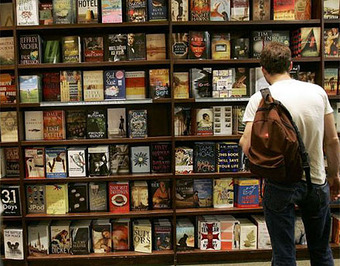
If you've ever spent any time in a European bookshop, you’ve probably noticed that the default book format is paperback. And the European paperback original is usually a sleeker, prettier, altogether more satisfying visual and tactile experience than our domestic trade paperbacks.
I’ve been waiting eons for that long promised ascendancy of the paperback original in the US book market. When did Bright Lights Big City first appear? 1984? At the time, we thought those genius Vintage Contemporaries might finally put a nail in the hardcover coffin. But in 2010, the conviction that every new fiction and nonfiction book has to appear sandwiched between clunky, unappealing cardboard slabs is more entrenched than ever.
If we’re lucky, the ebook threat might finally dislodge the dictatorship of the hardcover once and for all.
For years, publishers have resorted to the same collection of reasons why original books must be issued in hardcover.
Reviewers will not touch paperbacks.
Hardcovers are more durable and will last longer.
Americans just prefer hardcovers, it’s a cultural thing.
The economics of original paperback publishing won’t work.
But over the years, book reviewers have been much more willing to feature books in non-hardcover formats. (And in any case, better to worry about the continued existence of book reviewers themselves than about their format preferences.)
The deterioration in physical quality of some hardcover publishing has been depressing, and not unnoticed by bookbuyers. In the eighties, I remember joking about how many Doubleday Books you could stack up and carry (the old Doubleday, which used the same cheap paper as Book Club editions) because they weighed nothing. (One of the great things about working for university presses is that the physical and design standards are rigorous.)
Undistinguished blandness is often the physical book norm today. I groaned when I picked up Robert Darnton’s interesting defense of printed books published last year, The Case for Books. The book itself, which would have made a lovely paperback original, is a cheap, shoddily done hardcover with no aesthetic appeal whatsoever. The irony! Talk about undercutting an argument.
Like so many of the claims thrown around about what Americans “prefer,” the deck is heavily stacked in favor of what they’re being given. Are we American readers really so different from readers the world over, who overwhelmingly get their new books in paperback?
The economic question is the most compelling one, and most resistant to resolution. The simple truth is that a hardcover book carries a steeper price, and will, if successful, earn more money for publisher, author and bookseller. If issued as a paperback original with a necessarily lower price, more units would have to be sold. Projecting profit and loss based on conversion of a year’s worth of new books from mainly cloth to mainly paper is not a trivial exercise.
Yet one of the most constant refrains I hear from booksellers is that “this should have been paperback” when I’m trying to sell them on a new cloth title.
Publishing seems to be an industry inordinately obsessed with the Joneses. We do original books in cloth because the Joneses do them that way. If the Joneses started to do paperback originals, we’d do it too.
I’m hopeful that the challenges posed by digital media and ebooks will lead to some rethinking of the physical book as object. In fact, the ebook threat may not be to printed books per se, but to the dominant trade book model- clothbound, relatively expensive physical books.
If the standard price of a new trade ebook ends up being $12-15, wouldn’t an $18-20 beautiful trade paper edition be more competitive than a $30 cloth edition?
Except for art and heavily illustrated titles, for which hardcover can more often be justified, couldn’t we look to the European model for producing sensual, cleverly designed, durable paperback editions?
If somebody would start doing it, everybody would do it. Short runs of hardcover editions for libraries and collectors would still be possible. And cheap, minimalist editions in the $10 range (see semiotext(e)’s inventive and controversial Intervention series) should also have a future.
It seems logical to me. I’m not holding my breath. But even if we’re destined to live with our current two-step publishing norm- cloth edition, followed by paperback reprint one year later- there are some things we might do to breathe more life into the paperback.
Booksellers often hew a little slavishly (in my humble opinion) to the cloth track record when it comes to deciding on paperback reprints. It’s easy to see why- there is so little solid useful data around that when you see that you sold X number of units of the hardcover edition, you can make an informed bet on the paperback. It’s kind of exciting.
Some people bump the paper number a bit, expecting it to do better because it’s cheaper. Some people have a strict “sold three, buy three” approach, expecting the paper to perform just like the cloth. Some- and I won’t name names but this does happen- will look the book up and say “I didn’t sell any in cloth so I’ll pass” when a year earlier they said “This is too expensive, I’ll wait for paper.”
The point is, all of these approaches share a kind of routine thinking. Sometimes a paperback really does have a second life and might potentially reach a whole new audience, but not if it’s treated with a "cloth edition redux" shrug.
This was nicely argued in one of my friend Daniel Goldin’s recent blog posts about one of his favorite books last year, Chris Cleave’s Little Bee. The paperback is doing significantly better than the cloth did; you can read why here. (Hint: it’s finding its second life!)
With the proliferation of book clubs, it may be easier to imagine a second life for fiction than non-fiction. But the right non-fiction book, with the right package and the right story (see A Little History of the World) can spread exponentially in paperback.
In fairness, booksellers are not really to blame for not imagining reprint potential when publishers aren’t doing a very good job of it either. Too often we have a ho hum approach to paperbacks, and the result is ho hum sales.
I’d rather see, and I think we will see, a migration toward original paperback publishing over the next decade. Physical books as objects will get more beautiful, and riffs on the paperback format will proliferate. Or maybe American exceptionalism will carry the day again?
Friday, March 19, 2010
Books in the News

The vast scope of the product we sell- so many millions of titles- can sometimes seem like a disadvantage when compared to retailers offering a more finite menu of items. But in at least one respect the variety at our disposal is a huge advantage: there’s not a passing trend, piece of gossip or one day news item that can’t be readily addressed with a book.
Lots of people my age got into bookselling to begin with as an extension of their social and political commitments. Books can be weapons in the struggle, and all that. Plus, we couldn’t ever imagine functioning in the tainted corporate world.
No bookseller had more political convictions than my late mentor David Schwartz, but he used to confound the younger booksellers with his rule against wearing political buttons or T-shirts while on duty. “That’s what the books are for, use the books,” he’d always say.
So the concept that books are ideas and ideas change the world is not so original, but what’s sometimes over-looked is the competitive advantage we have over other enterprises when it comes to responding to ephemeral news events.
From a merchandising standpoint, you can think of a store’s book inventory in three ways:
1) There are the permanent, ironclad categories that have stood the test of time, like History, Science, Biography and so on. These may get a tidy-up or some new face-outs as books come in but for the most part they seem eternal;
2) There are some contemporary sections that are more responsive to political and social events. I’m thinking of Gender Studies, Environmental Studies, or the sections on Communities or Sustainability popping up in so many stores. Because you wouldn’t have found these in bookstores fifty years ago, they are more fluid than the old stand-bys. But as they become fixtures they quickly begin to seem like permanent categories;
3) Then there are the rotating displays and promotions around predictable events and occasions, such as Christmas and St. Patrick’s Day, Gardening and Graduation, Poetry Month and Beach Reading.
I’d propose a fourth category that seems underutilized: the instant, short-lived displays assembled on the fly based on news events.
Booksellers have such an advantage in responding to events and trends with their merchandise. The clothing and lifestyle retailers, chronically behind the cutting edge, must feel jealous.
A bookseller can read a celebrity obituary at 7:00am and have a nice display of relevant books up by 9:00. She can see a list of literature in translation awards on a website and throw together a lovely table featuring the winning titles. Some contemporary political tussles (health care anyone?) go on for so long that they will soon belong in category one above. But there are always books on the shelf to back up a display on the headline of the day.
I remember seeing photos of how they used to post issues of each days newspaper in the old Soviet Union. Moscow readers would queue up and crane their necks to study these poster-like bulletins. (Why? They only cost a kopeck.)
Similarly, I sometimes imagine dedicating a part of the front window in my dream bookstore to books drawn from the news of the day- a permanent display that would change every 24 hours based on what the media were exercised about and/or people were thinking about. (Of course I also imagine big crowds coming in to buy them. “Yes, I saw that front page Times story and come to think of it, I should know more about Greece. Or Fess Parker.”)
I guess this is on my mind because when I heard about the suicide epidemic at Cornell the other day, my first thought was “we have the perfect book on suicide!” I know, it sounds a little crass, but it really is the perfect book. And it’s an example of what I have in mind for my daily “in the news” bookstore display.
I immediately reminded the Cornell Store book buyer about Thomas Joiner’s Myths About Suicide, being published by Harvard this month. Of course he’s a pro so he’d already begun to think about how books could be brought to bear on the situation.
Every season there are titles that weren’t anticipated as major books that rise up out of circumstances and strike a chord. Ten years ago when the unpleasantness with the Taliban first commenced, Yale happened to have a small print run book called Taliban by Ahmed Rashid, one of the most knowledgeable journalists on earth. It went to number one on the New York Times list because booksellers said “we have a book on that!” and displayed it. (Shameless plug: a new edition appears this month)
Perhaps the strangest recent out of nowhere, media-driven book happening involves The Coming Insurrection, the short, incendiary tract from a French collective called “The Invisible Committee.”
Published by semiotext(e) last fall and distributed by MIT, the somewhat dense, theoretical, utopian manifesto was initially picked up by a few stores who do well with polemical texts by intellectual agitators. (You know who you are.) But suddenly Glenn Beck discovered it and pronounced it “the most evil book” he’s ever read. Every time the hoopla dies down a bit he brings it back out, waves it around on his show, and his minions pour into bookstores looking for it. It’s a somewhat surreal exercise trying to imagine what a Beck fan would actually make of the book. But hey, a sale is a sale.
Lots of imaginative booksellers are already doing this type of drive-by display thinking, and I smile whenever I see it. But I’d love to see more of it. Bookstores have always been the go-to source for serious readers looking for deep, big picture background. But at the other end of the spectrum, there’s a slice of the public with the attention span of a gnat, and a media cycle measured in hours rather than days.
I would wager that any random daily newspaper would yield a dozen related display-worthy titles that simply have to be plucked from the shelves.
If I had a bookstore you could see them every morning in my window, right next to Pravda.
Monday, March 15, 2010
Books in series: smash Dewey Decimal thinking!

One of the undeniable advantages internet book retailers enjoy over bricks and mortar stores is the ability to sort and categorize their inventories in seemingly infinite ways.
The presses I represent- to their credit- publish many books that can be considered inter-disciplinary. As an aid to booksellers, librarians and catalogers, we assign subject categories to every book, but these are not necessarily obvious and can even be contentious.
The new titles on our spring lists had many straightforward category designations like “art,” “science,” and “literature.” But we also had some combinations like these:
- Design/Urban Studies/Transportation
- Photography/Environment
- History of Science/Women’s Studies
- Education/Computer Science/Race Studies
- Literature/History of Science
That scholarship ranges across disciplines is a great thing, but here’s the problem: whereas an online bookseller can present a book simultaneously to the photography buff and the environmental activist, the storefront retailer has to shelve the book in a physical location. Thus, reps and booksellers spend a great deal of our time hashing out, book by book, the best place to shelve it.
This can be a useful, clarifying discussion. Sometimes a book genuinely has multiple possible audiences. But sometimes the more we talk about it, the more apparent it becomes that the message is muddled, and perhaps the multiple categories is a sign that the author doesn’t exactly have a reader in mind. There’s a big difference between having too many distinct potential customer profiles, and having one vague, jumbled one.
When expectations for a book run high, it’s always possible to place the book in multiple locations in the bookstore. But typically every book still requires a primary section assignment, and the default unit of commitment these days is one copy.
I once saw a buyer at the University of Minnesota Bookstore (now retired) who was so obsessed with subject categories that he would simply take as many copies of a title as it took to keep one on every relevant shelf. (Needless to say, he was chronically over-inventoried.)
One related problem of the multiple categories dilemma is the “books in series on slightly different subjects” conundrum.
Like many publishers, we have a great collection of books in series. These are not like the numbered Young Adult sequels, which are actually pretty easy to get into the hands of the right customers. Ours tend to cross subject categories, yet are united by a uniform editorial approach, or a unique physical design, or some other characteristic that extends one good book idea to another. (See below for some examples)
But bookstores face a conceptual challenge: do we maximize the design impact (and sales) by displaying them together, or do we protect the sanctity of the category by using Dewey decimal thinking and shelving them where they technically belong.
I’m familiar with several series now that have enough critical title mass to see the results of different approaches, and I have to say the boundary-busting, shelve them together approach seems to yield better results. It requires some willingness to look past the apparent subject matter, which is hard to do. But over the past year I’ve heard and seen more booksellers experiment with breaking out of category thinking.
Like so many seemingly new ideas in bookselling, this is actually an old one. I fondly recall the late Great Expectations Bookstore near the Northwestern campus in Evanston. Books there were shelved by publisher (!) Crazy as it sounds, the store looked great, and customers tended to develop a loyalty to certain areas of the store just as they do in places that sort by subject. (Plus, as proprietor Jeff Rice would tell you, it made pulling returns a heck of a lot easier)
I visit a couple stores where the travel section is arranged by publisher and series. I’m a big fan of this approach. We tried it for awhile in the store I once managed, but I think it was defeated by the hassle of explaining to a customer who asked for books on France that they are here, and here, and here. It’s a legitimate issue.
So maybe not the whole travel section. But the point is that books in series often look fantastic together, and they lose that impact when each one is spined, by author, across various store sections. There’s lots of evidence that people who pick up one will pick up another, but they won’t see them, or even realize it’s a series, when they are distributed across the store.
Just to cite a few examples, here are a half dozen of my favorite books in series from Harvard, MIT and Yale. Any brave booksellers willing to experiment with anti-Dewey marketing could start here.
The Loeb Classical Library
The granddaddy of all book series, the familiar little green (Greek) and red (Latin) volumes sell surprisingly well in stores that dedicate a section to them. They range across subjects- epic and lyric poetry; tragedy and comedy; history, travel, philosophy, oratory, religion, medicine and math- but it seems unnatural to split them up. Next year we’ll celebrate the centennial of this noble endeavor, so start thinking about section space now!
Wonders of the World
Classics scholar Mary Beard, who edits this wonderful series about the world’s key cultural and historical monuments, describes it this way:
I suppose there are three intentions. The first is that I want these books to open up culture and history, as well as dissent about culture and history, through the contested life stories of individual monuments and wonders – real or imaginary.
Number two – and these are not meant to be hierarchical – is quite a simple one, and it’s to show that bricks and mortar, or concrete and marble, are always more than that.
And I think the third intention is that you want to help people to enjoy looking at monuments, and at the complexity of monuments – and to see that the complexity and the arguments are what’s fun about this. Sometimes, when people write for what they think of as a popular market, they think that they should make it simple, whereas I think that what you should be doing is helping people to enjoy how complicated it all really is.
This is an excellent little series of small, elegantly designed hardcover books (though they’ll be released in paper beginning this season with The Parthenon) which straddle several potential readerships: history buffs, architects, well-endowed travelers. Where they’ve been treated individually and shelved in isolation, they’ve not done so well; where they’ve been displayed en masse, much better.
Documents of Contemporary Art
This lovely series, done by London’s Whitechapel Gallery and MIT Press, features stunningly beautiful anthologies by artists and writers addressing key subjects in contemporary visual culture from quirky perspectives. The roster of contributors is top-notch, the pieces are short and punchy, and the very titles in the series ( The Everyday, The Sublime, Chance) demonstrate how refreshing it can be to break out of conceptual categories. These books have lavish jacket art and hip design at an affordable price. They cry out for display treatment.
Boston Review
A couple years ago, MIT began distributing small, chapbook-like contemporary issues books for Boston Review magazine. These appealing little hardcover books- short, accessible, challenging conventional preconceptions- look great together but are completely lost when dispersed and consigned to their technically correct subject areas. More than any other series we publish, this one ranges across vast terrain, but the eighteen titles so far have a distinct approach to public discourse and look fantastic together.
Margellos World Republic of Letters
Literature in translation is on fire these days, and this bold series is dedicated to: works of cultural and artistic significance previously overlooked by translators and publishers, canonical works of literature and philosophy needing new translations, as well as important contemporary authors whose work has not yet been translated into English. It’s designed to bring to the English-speaking world leading poets, novelists, essayists, philosophers, and playwrights from Europe, Latin America, Africa, Asia, and the Middle East, to stimulate international discourse and creative exchange.
This is the sort of publishing for the long haul that I’m really proud to represent and booksellers can be proud to sell. With six titles to date and more in the pipeline (Romain Gary’s zany Hocus Bogus, just published, has never been in English), these elegant volumes have already earned acclaim. The unique design element here is tactile- it’s subtle, but the trim size and heft of the volumes are as appealing as the excellent jacket illustrations.
If you’ve read this far, I’m a broken record by now. But they would look terrific shelved together.
Subscribe to:
Posts (Atom)