Friday, October 11, 2013

book notes from the heartland fall forum


 It sounds like a right-wing think tank, but it felt like a Midwest indie bookseller family reunion.  The Heartland Fall Forum convened in Rosemont, Illinois last weekend and brought together the two branches of the family, the Great Lakes Independent Booksellers Association and the Midwest Independent  Booksellers Association for a couple days of shop talk and schmoozing.  Like other publishers, I had a table on Saturday and showed off my wares.  Herewith a few anecdotes.


When reps talked with each other, the subject was typically jobs (ours), the economy, and the end game; when I talked with booksellers, the topics tended to be books, events, the workshops they’d just come from, and some new ideas they’d picked up.  Interesting.

Trying to psych out the reasons a book catches someone’s eye is hopeless.  I get a bite on an MIT science title, The Outer Limits of Reason, from Twin Cities bookselling icon David Unowsky, so I launch into my spiel about it.  He listens patiently and then says “I was just interested because you know the author’s name (Yanofsky) is another version of mine.”   Later, someone picks up the lovely memoir Raising Henry, with it's irresistible cover, so I launch into that one.  She also listens patiently and then says “it just caught my eye because my son’s name is Henry.”  Not to say either one of these folks is superficial- far from it!- but it's a little deflating.

Chris Conti, longtime Museum of Contemporary Art Chicago buyer, has just signed on as a Phaidon rep.  He describes himself as a “replicant.”

Michael Boggs of Carmichael’s in Louisville loves Susan Sontag: the Complete Rolling Stone Interview from Yale.   In a bit about high and low culture, he zeroes in on a quote about whether to love Dostoevsky or the Doors.  “Why do I have to choose?” she demands.  Michael grinned and said he’s making that his email signature.

Booksellers are such interesting people.  A woman I thought I knew explained that she’s pursuing a PhD in creative writing and her dissertation is on portrayals of lynching.

A floor bookseller from Common Good Books in St Paul lights up when he sees Glyn Maxwell's On Poetry.  “I’m reading that, it’s amazing!” 

A bookseller friend attended a panel titled “How to Handsell Subjects You’re Scared of.”  Good idea!  I’m thinking Sports, Computer Science, or teenage vampire.  But oddly, the examples cited were Mysteries, Science Fiction and Religion!  I guess everyone has their own personal bookstore category fright.

White white white white white.  One person of color spotted all weekend.  When will the book industry take up this elephant in our room?

Exuberant meeting with the owners of the new Literati Bookstore in Ann Arbor.  They loved Vaclav Smil’s Made in the USA, saw it as “perfect for Detroit.  There are all sorts of interesting start-ups happening.”  I asked about their biggest surprise since opening the store last year.  “People want academic books.  We started with too much commercial stuff!”

The hotel is hateful.  You can’t breathe, one half of the hall is too hot, the other too cold, there’s no place to sit, and it’s in the middle of nowhere near O’Hare Airport.  Last year the meeting was in downtown Minneapolis, which was great.  I complain about this to a GLIBA staffer and lobby for a downtown location (Milwaukee?)  But the colleague standing next to me- okay it was Stu Abraham- countered that it’s better to have it in a place where people are trapped, and not drawn away from the show by distractions.  Perhaps this is one difference between an experienced commission rep and a house rep.

 After selling a new list for months you think you’ve heard it all.  But then a bookseller picks up the small trim Religion Without God by Ronald Dworkin, and says “this looks and feels like a prayer book.  Very clever!” Nice.

The man at the Melville House Books booth is thrilled that Yale Margellos is doing Pierre Michon’s books in English.  “He’s so underpublished, that’s the book (Rimbaud the Son I think) I brought on the trip to read.”  When someone from a stellar literature in translation shop like Melville reads our books, it makes me kvell.

Two booksellers who don’t know each other scan my booth, picking up this book and that.  One points to Gombrich’s A Little History of the World and says to the other “if you don’t stock that you should, we sell it like crazy.”  Gold.

Many remark that the jacket of David Lewis’ book Impulse: Why We Do What We Do Without Knowing Why We Do It is the best impulse cover they’ve seen.

Halley, former Boswell bookseller and science fanatic, loves William Bynum’s A Little History of Science so much she says she’s getting a tattoo with one of the woodblock images.  I don’t doubt it.

Finally, the show was memorable for a few staples of previous shows that didn’t happen: not a single self-published author pitching a totally inappropriate book!   Maybe Amazon’s aggressive self-publishing program is at least saving us from that.   

Not a single person trying to sell me services like indexing, design, or free-lance editing.  The latter always makes me laugh given that our editors tend to be giants in their academic fields, so we’re covered on that.   

And, thankfully, not a single person asking me to help get their kids into Harvard, MIT or Yale.  This query is usually delivered in jest but with a desperate look that means “but really, you couldn’t, could you….?”

Saturday, September 28, 2013

I have a customer for that!

bookseller Lisa greets Mr G, downtown Milwaukee circa 1995

Nothing makes a rep’s day like a buyer who smiles and says “I have the perfect customer for that.” 

As digital tools continue to colonize our working lives, it’s easy to start thinking of “the customer” as just some sort of abstract demographic.  The stats may now tell you that 20% of the customers who bought a military history title from you also bought a cookbook.  But who were they?  These faceless demographics are surely helpful in some general way, but they mask the potent reality that bookselling is still a hands-on, person to person affair.


So I’m thrilled when a buyer knows that her sell-through on Philosophy is trending up, but I’m even more excited when she has names and faces in mind for the copies she orders.  To me, this has always been real bookselling, and is the secret weapon that will slay algorithmic tyranny in the end.

The real, live flesh and blood customers who shuffle in and out of bookstores all day inevitably become familiar.  It’s what we say we want- a feeling of community, of ownership: “I’m going down to my bookstore this afternoon.”  Where they know me.

Though I’ve been out of the retail end of things for years (I managed the downtown Milwaukee Harry W Schwartz Bookshop in the nineties), I’m amazed at how easily I can recall my own special customers, the readers who’d come to mind when a rep pitched a book to me.  These were people who shaped the store and our daily working lives.  With a bit of nostalgia, I wonder what’s become of these twenty formerly familiar faces.

 1) Ron J, the rich bookaholic lawyer who lined his office with hardcover copies of the latest fiction.  He took every recommendation we could give him, and we delivered;

 2) Jacqueline D, working on her PhD in English Lit.  She scoured TLS and British literary journals and ordered hundreds of titles we’d import at great expense.  We wondered where she got the money, the time, and the smarts.  It was a huge feeling of accomplishment to hand sell her something she’d missed;

3) Rev. W was in the store daily when he was in town, knew our Music section by heart, read widely in history and philosophy (religion, oddly, not so much).  He got in a bit of trouble later but we loved him as a customer;

 4) Mr. K, not a customer per se as I never remember him buying anything.  But a daily fixture: grizzled, thick smeared spectacles, filthy clothes, a half dozen shopping bags stuffed with newspapers that never left his side, and a half cigar that he never lit.  Incomprehensible monolog, claimed to have had dealings with Harry W. himself.  New staff were always afraid of him, then came to love him, then came to dread his time-consuming and smelly morning visits;

5) Mr. B:  short, stout, red-faced, officious, with a nearly indecipherable German accent, which didn’t much matter since his only requests over the course of five years were for the German newspaper Die Zeit.  It was never there on the day it should have been.  This was always our fault;

6)  Min K, the grande dame, a store favorite, she doted over us and we over her.  She looked, dressed and behaved as if she’d stepped out of the Romanov court yet worked in a downtown office building.  Her reading tastes were impeccable, and she couldn’t resist a sophisticated biography.  She knew the entire staff by name, and their birthdays.

 7) Mr G, an eccentric fixture.  He had some sort of dementia and would come into the store every single day with two questions: “what time do you close?” and “is there a tax on magazines?”  The answers never varied, but neither did the questions.  He would sometimes call women “sir,” though never called male staff “madam.”  He had a set of false teeth and as he perused magazines he’d habitually slide the top layer in and out of his mouth entirely, an alarming sight;

8)  Cute Pop Culture Guy, whatever became of you?  Every boy and girl on staff had a crush on you, and looked forward to your daily visits;

9)   Mary, good friend of the owner,  loved his willingness to act as personal shopper.  Though her reading tastes were not unusual and any of us could have helped her, she enjoyed having David’s undivided attention and recommendations;

10) Tom B, photography buff.  Never bought a book to my knowledge but offered regular critiques of our Photography section, which was never up to snuff.  Oddly, I felt him looking over my shoulder when I was presented with a Photo book, thinking to myself “we’ll never sell it but Tom won’t be able to complain";

11) Mr Art Man: suave, dapper, possibly European, elderly, came in at least weekly, carefully perused the art section and spoke to none of us.  He was a regular and we didn’t pay him much mind, until one day, shockingly, a bookseller noticed him walking out the front door with a load of art books under his coat.  He’d been a patron for at least five years and robbing us blind while we looked for thieves among the rowdy teen-agers changing buses on our corner;

12)  Paul C, one of the finest local musicians Milwaukee has to offer, and one of the most well-read.  He had me at Flannery O’Connor.  And he’s still a bookaholic- the other night when my local bookstore, Boswell Books, was closed for a staff meeting,  I noticed Paul peering in from outside;

13) Cathy S, a true Milwaukee original.  Heavy-set, butch, black denim head to toe, chain wallet, glasses, spoke out of the side of her mouth- she used to exchange postcards with Burroughs.  She was a guidance counselor in a suburban high school, figure that!  She had a "been there/done that" world weariness in her voice- ask her “how are you” 100 times and 100 times she would sigh “surviving…”  Yet she was passionate about books, music, movies- bought anything and everything we’d recommend, and was in the store just about every day.  One of the last times I saw her she was waiting online for a signed Patti Smith;

14) Mr B, older wealthy retired gentleman.  Struck up a friendship with one of the quieter, nerdier guys on the staff.  He’s the only one he’d listen to on book recs and he amassed a vast personal library.  Rumor had it that the bookseller made out quite nicely when Mr B died;

15) Dr F, a dour, somewhat intimidating psychiatrist for whom we always felt we were failing.  Why is it that small errors and mix-ups seem to attach themselves to the people with the lowest tolerance for them?  But she was a good customer and ordered lots of books;

16) Kathy H, a waitress, my favorite kind of regular, popped in on pay day or if she had a pocketful of tips, always asked what’s good.  We knew her.  If a juicy gothic mystery came in someone would say “put that one aside for Kathy,” and usually someone else already had;

17) Mayor N, big and tall and impossible to be anonymous, but he loved to walk over from City Hall on his lunch hour.  We’d give him space, though he liked talking to booksellers and was surprisingly up to speed on the latest new urbanism books and good novels;

18) Mr P fancied himself a mover and shaker, loved to have us wrap and send out books as gifts to business associates far and wide.  Only we knew that they had to be cheap remainders, with the price stickers surgically removed;

19) Mrs J, 80-something, who used a wheelchair, would arrive at the store every few weeks with her companion in an emergency vehicle.  She had won this service in perpetuity in some dispute with the city.  Once inside, she wheeled herself through the store on the lookout for books for her niece in Norway.  Though our ace bookseller handled her with great tact and love, she limited her enthusiasms to the books she could see, which happened to be mass market displays at eye level.  She could be cutting.  “She [her usually silent but no doubt long-suffering companion] might be interested in this,” she’d snort.  “All she ever reads is the newspaper!”

20)    Dennis P, the bookseller’s dream customer.  If every bookshop across the land had a Dennis, the future of the book would be secure.  A lawyer by profession but a self-taught intellectual by persuasion, he has a bottomless thirst for knowledge and reading.  He puts books on order before they are even published, yet is always open to suggestion.  He has the quaint idea that books can change the world.  I can’t count the number of times as a buyer I said to my rep “this is a Dennis book,” and how many times, as a rep,  I hear the same phrase from the buyer at Boswell, his current store.  Long live Dennis!


Sunday, August 25, 2013

Pick up the new Baffler now: ten good reasons


Twenty-five years ago Tom Frank and friends started a small journal in Chicago called The Baffler.  Like his first book, The Conquest of Cool, the journal limned the many ways cultural authenticity has been co-opted, branded, and regurgitated by corporations and institutions.

There was a lot of subject matter to work with in Millennial capitalist America.  The magazine struggled, and even took a break for awhile.  But most of the early issues, some of which have been anthologized, stand up amazingly well.  If anything, the corporate onslaught has become even more refined and insidious. 

Recently The MIT Press picked up distribution of the journal.  The Baffler website has been spiffed up, its back on a three times a year publishing schedule, and the roster of contributors just keeps getting better.   There’s really nothing like it in the world of cultural and political long-form journalism.  And for twelve bucks!

The 25th anniversary edition of the magazine, just out, is fantastic.  I highly recommend that you stop reading this right now and go out and get yourself a copy and read that instead, cover to cover.  But if you need nudges, here are a few of the sacred cows smashed in this issue:

1)  In “Academy Fight Song,” Tom Frank shows “how virtually every aspect of the higher-ed dream has been colonized by monopolies, cartels, and other unrestrained predators.  The charmingly naïve American student is now a cash cow, and everyone has got a scheme for slicing off a porterhouse or two… ours is a generation that stood by gawking while a handful of parasites and billionaires smashed higher ed for their own benefit.”

2) “Facebook Feminism, Like it or Not” is a much needed takedown of Sheryl Sandberg’s phenomenally successful Lean In, by feminist scholar and journalist Susan Faludi.  “Never before have so many corporations joined a revolution,” Faludi writes.  “Virtually nothing is required of them- not even a financial contribution.”  The transcript of her attempt to get some questions answered by the Lean In PR department is sad and hilarious.  (Example: “Q: Would you encourage a Lean In Circle to picket a discriminatory employer?”  A: blah blah blah blah blah.)

3) In “Networking into the Abyss,” a pointed and genuinely Menckenesque critique of the altcult mecca South by Southwest, Jacob Silverstein efficiently eviscerates this trendy marketing event.  “During SXSW, Austin becomes a money-soaked mélange of hyper-consumerism and techno-utopianism… the marketing machine doesn’t only want to sell to you; it wants you to sell your own networked persona on its behalf.”

4) In “All LinkedIn with Nowhere to Go” Ann Friedman makes mince meat of the ubiquitous get-ahead site, and its philosophy of wish fulfillment as business model.  “The roots of the LinkedIn vision of prosperity-through-connectivity lie in the circular preachments of the positive-thinking industry,” she writes.

5) In “Street Legal: The National Security State comes Home,” Chris Bray makes a bone-chilling case that “the contest between the centralization and decentralization of information is the real culture war of our moment.”

6) The rise of the right-wing think tanks is explored in all its depressing glory in Jim Newell’s “Good Enough for Government Work: Conservatism in the Tank.”  “The perpetually aggrieved American right can rest easy: the conservative movement has, indeed, won the war of ideas.”

7) In part, as Ken Silverstein explains in “They Pretend to Think, We Pretend to Listen,” because of the corporate takeover of liberal think tanks!

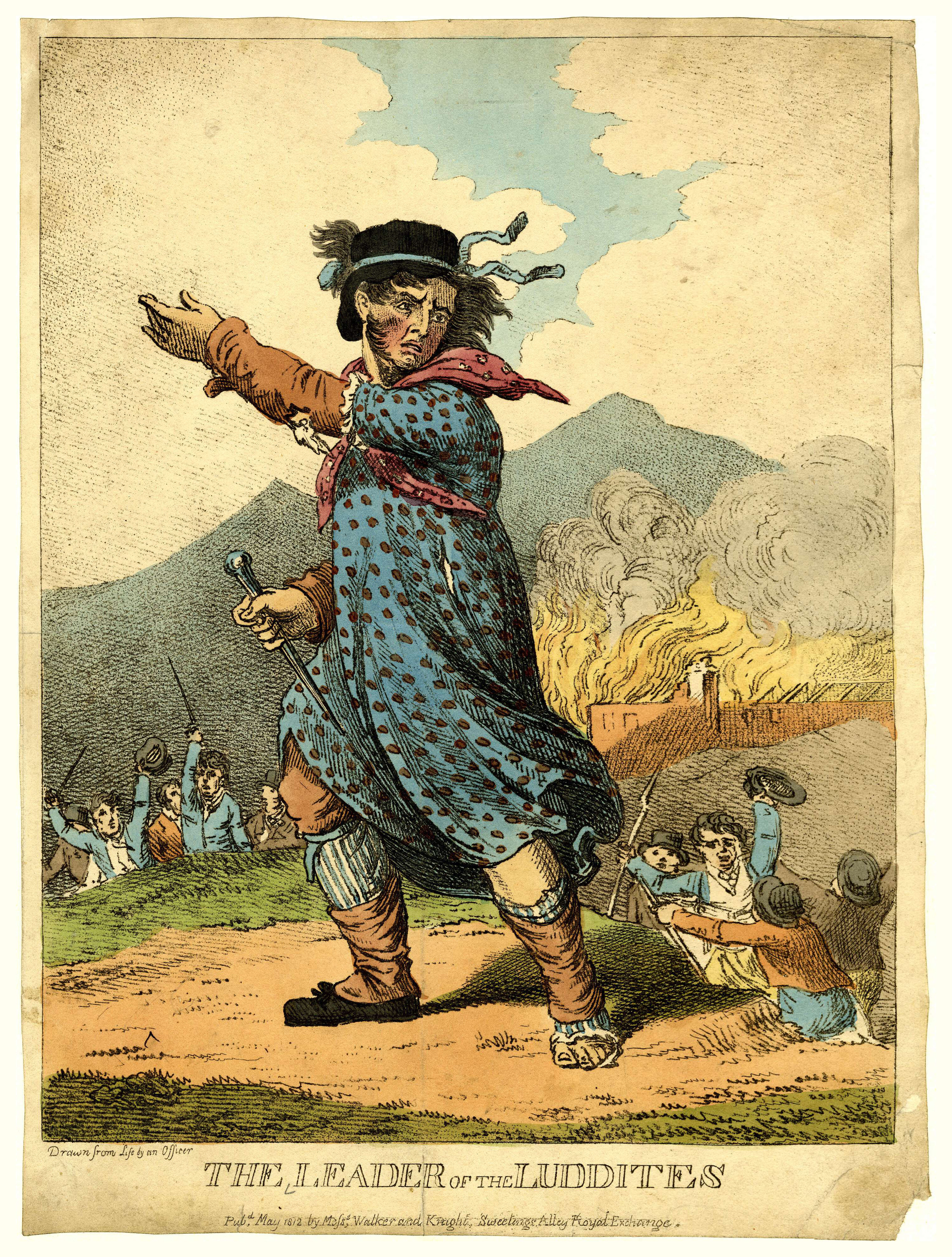
8) In “A Nod to Ned Ludd,” (worth the price of the magazine alone), Richard Byrne does a huge service by illuminating the true story behind a term we throw around as if we knew what it meant: “luddites.”  Just about everything you think it means is wrong.

9) “On Wittgenstein’s Steps” is a surprising and lovely rumination by Croatian writer Dubravka Ugresic on pigeons, sculptures, and the meaning of public monuments in a time of political transformation.

10) And in “Sacking Berlin,” Quinn Slobodian and Michelle Sterling mourn the disappearance of the whimsical, playful, authentic Berlin that emerged post-1989 and its replacement by “branding, clicking, swiping… a privatized Berlin.”  They lament that “the monuments of East Germany have been demolished, social services have been sold off, and with them have gone the memory of the city as a place of shared public goods.”

And there’s more!  Poetry, stories, cheeky graphics and cartoons, book and movie reviews- 162 pages that will make you laugh and make you a better person.  Inquire at your bookstore or see TheBaffler.com for more info.